 Rango
Rango
Rango fees vary with swap deductions and separately funded network charges
Rango fees can include protocol deductions, network gas and charges configured by the swap interface. Deductions marked as output reductions are already included in the quoted receive amount. Wallet-funded gas needs an available balance, while the direct Rango app and third-party integrations can use different service-fee arrangements.
· updated
An output deduction already included in a Rango quote shouldn’t be subtracted again when comparing net output and separately funded charges.
Network, Provider and App Charges
Network gas pays for blockchain execution, while provider fees pay the exchange or bridge handling the route. A decentralized exchange (DEX) may charge for token conversion. A bridge may charge for transferring assets between networks. These charges belong to the underlying services, even when Rango presents them together. A cross-chain swap can involve both kinds of provider, so its cost breakdown needs to cover every included operation. Rango’s direct swap app doesn’t add an app fee; required network and provider charges still apply.
Wallets, embedded widgets and other API integrations can include protocol and affiliate charges. Their arrangements can differ, so an integration’s Rango Fee label doesn’t establish the direct app’s fee policy.
Fee Parameters and Funding Requirements
Rango’s fee data identifies how a charge affects the swap and which balance funds it. A source-wallet charge requires the specified asset on the relevant network. A destination-wallet charge can fund a bridge claim when that route requires one. An output deduction reduces the amount obtainable through the swap. The fee’s payment mode, asset and amount explain the funding requirement more precisely than its display name alone.
| Parameter | Documented Value | Cost or Funding Effect |
|---|---|---|
expenseType
|
FROM_SOURCE_WALLET,
DECREASE_FROM_OUTPUT
or
FROM_DESTINATION_WALLET
|
Identifies wallet funding or an included output deduction. |
avoidNativeFee
|
true
|
Excludes providers charging native-token service fees; network gas remains payable. |
referrerFee
|
Configured percentage of the input amount | Sets an input-based affiliate charge; Basic API quote and swap settings must match. |
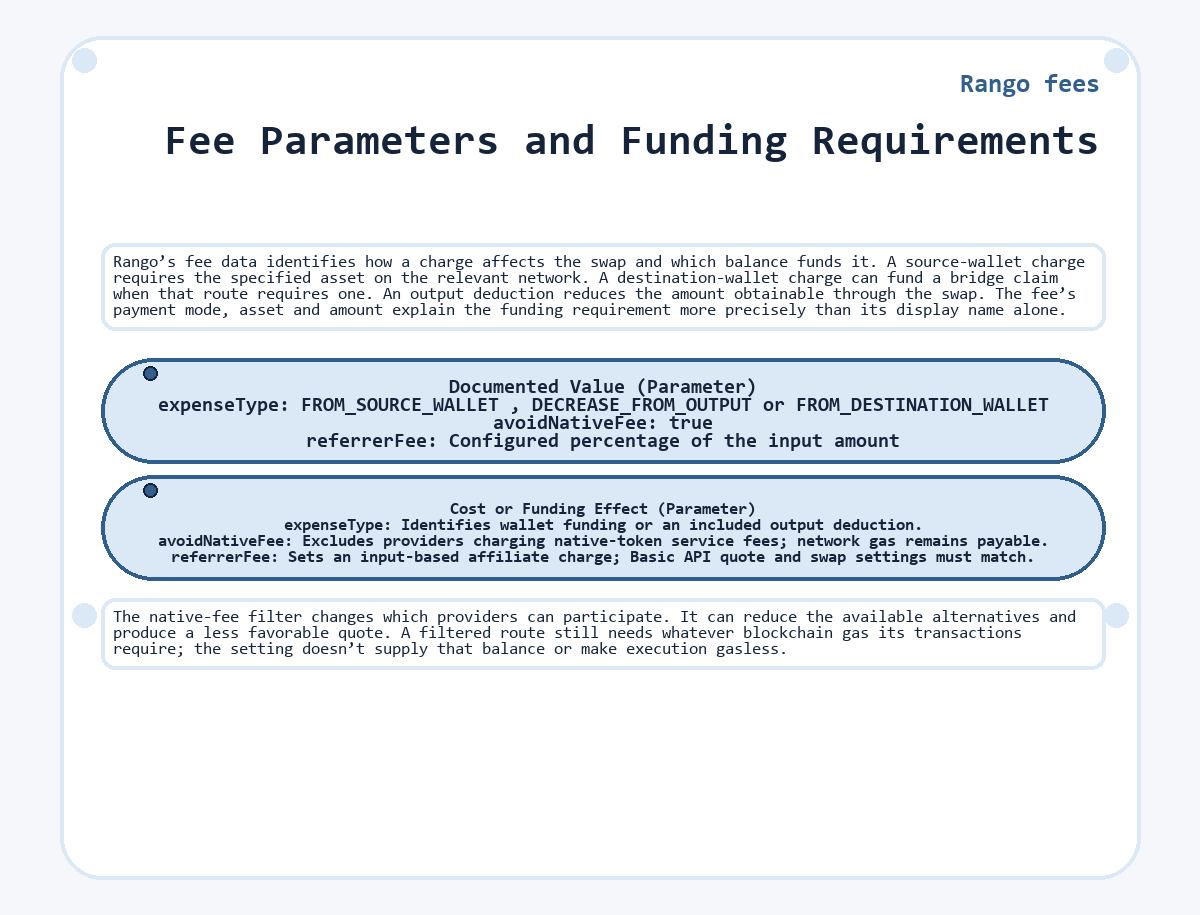
The native-fee filter changes which providers can participate. It can reduce the available alternatives and produce a less favorable quote. A filtered route still needs whatever blockchain gas its transactions require; the setting doesn’t supply that balance or make execution gasless.
Does the Quoted Output Already Include Deductions?
Fees marked
DECREASE_FROM_OUTPUT
are already reflected in Rango’s estimated output.
Subtracting those listed deductions again understates the amount quoted. Source- and destination-wallet charges need separate accounting. The Basic API also distinguishes expected output from minimum output through
outputAmount
and
outputAmountMin. These describe a quote, while a completed swap has an actual received amount and asset.
Gas Limits and Wallet Estimates
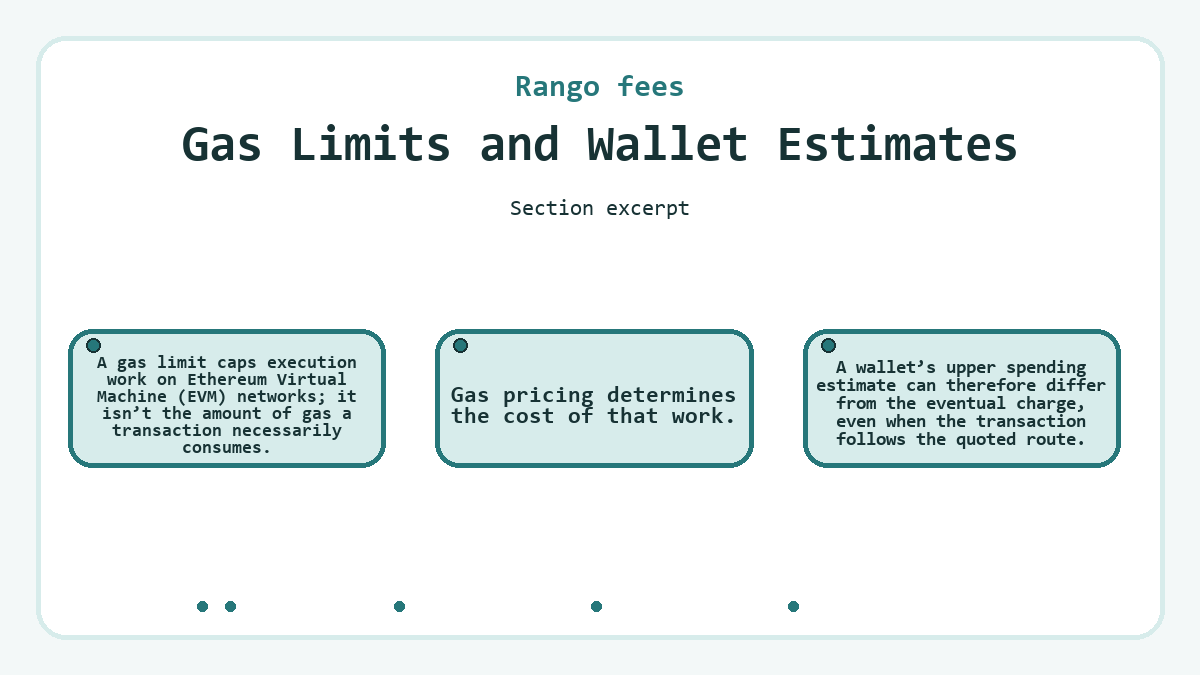
A gas limit caps execution work on Ethereum Virtual Machine (EVM) networks; it isn’t the amount of gas a transaction necessarily consumes. Gas pricing determines the cost of that work. A wallet’s upper spending estimate can therefore differ from the eventual charge, even when the transaction follows the quoted route.
Rango can apply safety margins when preparing transactions because complex execution is difficult to estimate precisely. Gas consumption can peak before execution finishes and applicable refunds take effect. Setting the limit only to a predicted net figure can leave too little room for the transaction to complete.
Unused gas allowance isn’t automatically spent. The execution charge follows the gas actually charged at the applicable price, within the transaction’s fee rules. A larger gas limit can increase the balance a wallet needs available without making that entire estimate the final payment.
Some bridges also use fee buffers and return an excess payment under their applicable mechanism. These refunds don’t establish a refund rule for every provider charge, affiliate deduction or unsuccessful route.
Any separately submitted token approval adds another transaction to the cost accounting. Its gas belongs alongside the swap’s gas when assessing the full expense. The swap preview and each wallet request serve different purposes: the preview estimates a route, while the wallet request exposes the transaction being authorized.
Affiliate Charges in Wallet and Widget Integrations
Integrators can configure an affiliate charge based on the input amount, which changes the economics of the displayed swap. The Basic API uses
referrerFee
when obtaining a quote and creating the transaction. Matching those settings keeps the estimated charge aligned with the requested execution. The Main API carries its affiliate settings in routing requests, including
affiliatePercent
and the configured recipient information. A widget’s affiliate configuration can likewise add a charge for swaps performed through that integration. The payment asset and collection method can vary with the supported route and commercial arrangement.
A percentage can’t be compared directly with fixed gas denominated in another asset. Cross-interface comparisons also need matching input and destination selections, since provider filters can change available quotes.
Why Can Small Swaps Have a Higher Effective Cost?
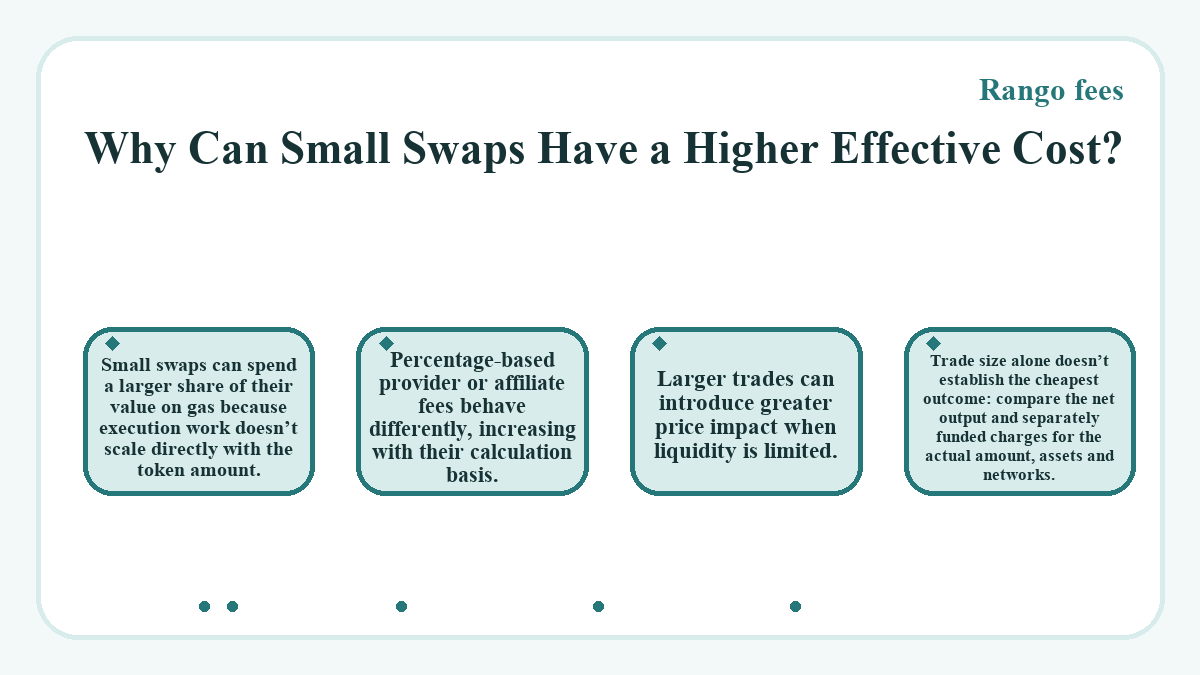
Small swaps can spend a larger share of their value on gas because execution work doesn’t scale directly with the token amount. Percentage-based provider or affiliate fees behave differently, increasing with their calculation basis. Larger trades can introduce greater price impact when liquidity is limited. Trade size alone doesn’t establish the cheapest outcome: compare the net output and separately funded charges for the actual amount, assets and networks.
Final Charges and the Gas Refund Boundary
Gas already consumed by an executed EVM transaction remains a cost if that transaction reverts. A returned swap balance doesn’t establish repayment of that gas. Conversely, a transaction never submitted for blockchain execution hasn’t consumed execution gas. Previously completed approvals can still have their own charges, so abandoning an unsigned swap doesn’t erase every earlier expense.
Final accounting separates the asset actually received from the network fees recorded for each executed transaction. Cross-chain processing can continue after the source transaction succeeds, so a source receipt alone doesn’t establish final delivery. Rango’s status response can distinguish the desired output from input refunds and intermediate-asset outcomes. In the Basic API, the received quantity is
output.amount, paired with
output.receivedToken.
Rango fees - your questions answered
Does Increasing Slippage Tolerance Add Another Rango Fee?
Slippage tolerance sets an acceptable execution difference and isn’t itself an additional fee. Raising it can permit a worse execution price within the accepted boundary. Provider charges and network gas remain separate cost inputs. A minimum received amount describes the route’s execution constraint, rather than a percentage automatically paid to Rango.
Are API Fee Amounts Always Expressed in Token Units?
API fee amounts need the unit convention of the endpoint returning them. A base-unit amount requires conversion using the fee asset’s decimals; a human-readable amount already expresses token units. The token used to pay the charge matters too. Don’t apply the destination token’s decimals to a fee denominated in a different asset.
Will Requesting a Rango Quote Spend Network Gas?
Requesting a route quote doesn’t submit a blockchain transaction, so the quote request itself doesn’t consume network gas. Gas becomes relevant to transactions submitted for execution, including a separate approval when required. Receiving transaction data from the API also doesn’t establish that a transaction has been broadcast or executed.
Can an Earlier Token Approval Avoid Another Approval Charge?
A sufficient existing ERC-20 allowance for the required spender can remove the need for another approval transaction. Its applicability depends on the network, token, spender and remaining allowance, not merely an earlier swap using Rango. An abandoned swap doesn’t automatically revoke a confirmed allowance. The next transaction still needs its own execution funding.
Why Can a Transaction Include a Native-Token Payment Beyond the Swap Input?
Some providers require a native-token service payment in addition to the swap input. That extra payment can increase the transaction value independently of network gas. A wallet’s transaction value and its gas estimate therefore describe different charges. For token inputs, a nonzero native-token value can cover a provider payment while the token amount is handled separately.
Is a Failed Rango Swap Always Refunded in the Original Asset?
A failed route can return the input asset or leave an intermediate asset, depending on where execution stopped and the provider’s mechanism. Rango’s output status distinguishes these outcomes. Some bridge refunds require a separate action. Neither a failure label nor a returned token establishes reimbursement of every fee already incurred.
What Does a Missing feeUsd Value Mean for the Swap Cost?
A missing dollar-valued fee estimate doesn’t establish that the route is free. Fee entries still identify their amounts and payment assets. Without a usable conversion estimate, those amounts need to remain in their own units. A missing aggregate dollar figure also can’t establish whether the required wallet balance is sufficient.
Do Affiliate Payouts Go to the Person Making the Swap?
Affiliate payouts go to the configured affiliate recipient, which may be the integrating app or referrer. The swap’s recipient address separately determines where the swap output goes. Rango’s affiliate recipient settings don’t establish a rebate for the person paying the fee, and the payout asset or settlement method depends on the applicable arrangement.